Bollo Lane Level Crossings Could Close
TfL raises possibility in new West London Orbital plans
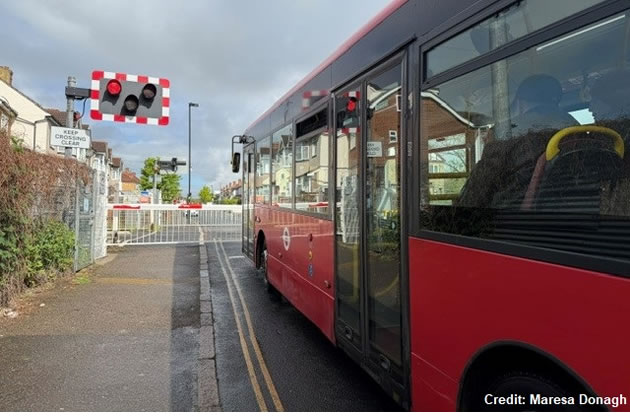 Level crossing at Bollo Lane
September 25, 2026
One or both of the level crossings on Bollo Lane could potentially be closed as part of plans for the new West London Orbital railway.
Transport for London is considering the future of the crossings as part of a consultation on the new route. This is because adding regular passenger trains to railway lines currently used by existing services and freight would substantially increase the number of train movements.
The proposals form part of the planned West London Orbital, a new London Overground service running between Hounslow and Hendon. TfL's current plan is for four trains an hour over the whole route, with six an hour operating on its northern section between Old Oak Common Lane and Hendon. Existing freight trains would continue to use the railway alongside the passenger service.
TfL is warning that the additional West London Orbital services could require level crossings on the route to close to road traffic. Its assessment is that retaining crossings with the increased frequency of trains could mean barriers remaining down for significant periods, creating concerns about safety and congestion.
Under current railway operating rules, the level crossing barriers - which are already lowered for around 40% to 50% of the time during the day - would be closed for longer periods and the safety risks of continuing to operate the crossings would increase. TfL believes there could be an increase in risk taking behaviour from drivers and pedestrians frustrated by a long wait to cross the railway. When WLO services are added, the barriers would be lowered for up to 75% of the time for periods as long as 11 minutes at a time. While technology improvements are being explored this could only partly mitigate the closure times.
Bollo Lane has two level crossings in close proximity to each other. These are the ‘Kew line’ to the north, which would be used by WLO services, and is currently used only for freight trains and the ‘Richmond line’ to the south, which is currently used by both Mildmay line and freight services. Due to the proximity of the crossings, if they were to remain open to traffic when WLO services begin to run, the barriers on both crossings would need to come down for a train passing on either line, to avoid the risk of vehicles queuing over the other crossing.
Currently TfL believes it would be more practical to close the Richmond line level crossing on the Mildmay line, rather than the Kew Line (potential WLO) crossing because this would ensure access remains available to Chiswick Business Park and other properties between the two crossings, including for bus routes 440 and 70, so these bus routes would not need to be changed. The Kew line barriers for WLO trains to remain open for traffic for around 60 per cent of the time .
If this crossing has to close, the most likely option to maintain pedestrian and cycling access at this location could involve a new pedestrian/cycle bridge. TfL is also considering whether alternative pedestrian and cycle arrangements could be provided at nearby locations.
The situation at Bollo Lane presents an additional complication because of railway heritage.
TfL's consultation identifies implications for the listed, disused Bollo Lane signal box if changes are necessary at the crossing. If a proposed pedestrian bridge is ultimately confirmed as being required, TfL says its intention would be to relocate the signal box. Options would be discussed with heritage organisations and Ealing Council with the intention of protecting the structure.
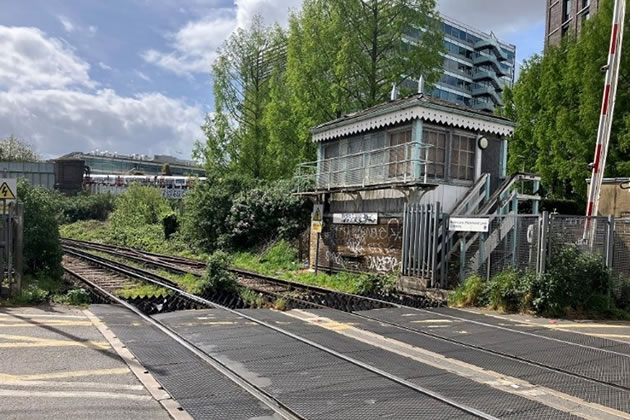 Bollo Lane signal box may need to be relocated
The West London Orbital remains a proposal and TfL says feedback from the current consultation will help determine how it develops the scheme. TfL says more generally that it is investigating alternative arrangements at the affected crossings as the design work progresses. The detailed solution has therefore not yet been settled, leaving important questions about the consequences of a road closure and how existing movements across the railway would be accommodated.
While welcoming the West London Orbital project as a whole, Bassam Mahfouz, London Assembly Member for Ealing and Hillingdon, said, “But better transport links must not come at the expense of existing connections. This could have a significant impact on pedestrians, cyclists and drivers, who may face long detours with no convenient alternative routes. The West London Orbital should enhance connectivity and accessibility, not reduce it. TfL must properly address these concerns.”
The West London Orbital would create a new orbital public transport connection across west and northwest London, allowing many journeys to be made without travelling into central London.
The proposed service would run from Hendon through Brent Cross West, along the Dudding Hill Line and through Old Oak Common Lane. South of there, trains would join tracks used by the existing Mildmay line and call at Acton Central and South Acton. From South Acton, the service would move onto another freight line running through Chiswick and serve a new station at Lionel Road, close to Kew Bridge station. It would subsequently join the Hounslow Loop, serving Brentford, Syon Lane and Isleworth before terminating at Hounslow. TfL says four trains an hour would operate throughout the route between Hendon and Hounslow. Two additional trains an hour would operate between Hendon and Old Oak Common Lane, producing six trains an hour over the northern section.
TfL argues that the West London Orbital would fill a major gap in London's transport network by providing direct links between areas of west and northwest London which currently require more complicated public transport journeys.
For local residents, key issues are therefore likely to include what alternative routes would be available if the roads were severed at the railway, how pedestrians and cyclists would cross the line, and what effect any changes could have on surrounding roads. Bollo Lane is not the only potential level crossing closure with the ones at Churchfield Road in Acton and Wood Lane in Isleworth also at risk.
The consultation is specifically intended to identify matters requiring further investigation as the designs develop.
The public consultation on the West London Orbital is open until 18 November 2026.
Like Reading Articles Like This? Help Us Produce More This site remains committed to providing local community news and public interest journalism. Articles such as the one above are integral to what we do. We aim to feature as much as possible on local societies, charities based in the area, fundraising efforts by residents, community-based initiatives and even helping people find missing pets. We’ve always done that and won’t be changing, in fact we’d like to do more. However, the readership that these stories generates is often below that needed to cover the cost of producing them. Our financial resources are limited and the local media environment is intensely competitive so there is a constraint on what we can do. We are therefore asking our readers to consider offering financial support to these efforts. Any money given will help support community and public interest news and the expansion of our coverage in this area. A suggested monthly payment is £8 but we would be grateful for any amount for instance if you think this site offers the equivalent value of a subscription to a daily printed newspaper you may wish to consider £20 per month. If neither of these amounts is suitable for you then contact info@neighbournet.com and we can set up an alternative. All payments are made through a secure web site. One-off donations are also appreciated. Choose The Amount You Wish To Contribute. If you do support us in this way we’d be interested to hear what kind of articles you would like to see more of on the site – send your suggestions to the editor. For businesses we offer the chance to be a corporate sponsor of community content on the site. For £30 plus VAT per month you will be the designated sponsor of at least one article a month with your logo appearing if supplied. If there is a specific community group or initiative you’d like to support we can make sure your sponsorship is featured on related content for a one off payment of £50 plus VAT. All payments are made through a secure web site. |